

[cmsms_row][cmsms_column data_width=”1/1″][cmsms_text]
The new standard of local quality anesthesia for temporary teeth: CDS-IS with Wand / STA
Effective pain control during dental treatment at children is of paramount importance in achieving comfort, maintaining cooperation, and long-term compliance. However, nowadays – with all the technological advances acquired (atraumatic needles, state-of-the-art anesthetic solutions, etc.) – the administration of local anesthesia to a preschooler/pupil is another milestone in pediatric dentistry (2) given that:
The first 2 ones (penetration of the oral mucosa and deposition/infiltration of the intertissued anesthetic solution) produces pain and then analgesia.
Analgesia obtained through local anesthesia may be insufficient at 11.6% of children aged 26-80 months¹.
Pain felt by the child during dental treatment under local anesthesia is not always taken into account due to the “illusion of certainty” ³ or “pain blindness” ³, unconscious attitudes of the doctor that develops due to routine. Otherwise – when the presence of pain is accepted by the doctor – it can be attributed to age (), sex (), associated symptoms (), fear/anxiety of injection (), type of treatment (), location of the tooth (jaw/ mandibular) (), whether or not to use inhalation with nitrous oxide (), local anesthetic method ().
Methods of analgesia of mandibular and maxillary temporary molars:
Anesthesia of temporary mandibular molars:
The anesthesia routine method of mandibular molars is through peripheral trunk anesthesia (Spix, etc.) ¹. However, this method has some disadvantages:
- it is more painful than an oral infiltration, sometimes influencing the child’s behavior and cooperation (34).
- efficiency limited to 63-87% (11-13, 35, 36).
- the long duration increases the possibility of postoperative trauma such as biting the lips or cheeks.
Local infiltration at the oral level with Articaine (as an alternative to trunk anesthesia) has an uncertain efficiency, according to some authors, of a maximum of 65% (1).
Intraligamentary infiltration with a classic high-pressure syringe is the second alternative to trunk anesthesia. This method though has some advantages:
- easy administration
- absence of anesthesia to neighboring soft tissues
- the relatively short duration of anesthesia effect
- low volume of anesthetic solution (an important aspect in pediatric dentistry)
However, the pressure-injected anesthetic solution may interfere with the development of the dental bud of the corresponding permanent tooth (39). This technique is also associated with postoperative pain (longer than 7 days after injection) (40-43).
Anesthesia of temporary maxillary molars
The most commonly used method in temporary anesthesia of maxillary molars is supraperiosteal/ buccal infiltration. However, this method is often ineffective due to deep localization of the apexes of the roots of the second temporary molar, present in the zygomatic bone – which may be too dense and hard to allow infiltration of the anesthetic solution (29, 30). Palatal nerve anesthesia is considered the most painful method of local anesthesia for a child.
………………………………………………………………………………………………………………………………
In search of an atraumatic and effective method of local anesthesia, the new standard of local analgesia was discovered in 1999: CDS-IS / Wand / STA, Milestone Scientific. (Fig. 1)
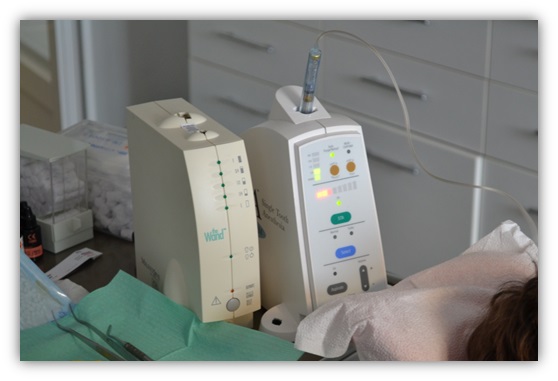
Indeed, for 160 years – since the hypodermic syringe was invented and improved (Lafarque-1836, Jayne-1841, Wood-1843, Pravaz-1853) – local anesthesia has never been revolutionized more than it is now, thanks to technology. Electronically controlled L.A. using Wand / STA, Milestone Scientific. STA equipment can be used with high efficiency (Malka) for:
- all the classical techniques listed above (using the prepuncture and birotational technique, Sixou)
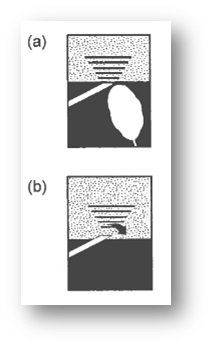
With the bevel oriented in parallel, press it on the mucosa for 10 sec (do not penetrate). Activating Control Flo a few drops of anesthetic will initiate topical anesthesia (the excess is absorbed with a roller, fig 2.a.). Maintaining the same inclination, the needle is pivoted 45 ° to the right and left, penetrating for 8-10 seconds the top of the periosteum (fig. 2.b.). Slow flow anesthetic deposition (STA Mode). Holding the needle in place until the anesthetic solution disappears – about 8 sec. Slow retraction of the needle (absorption of excess with a roller) ends the procedure.
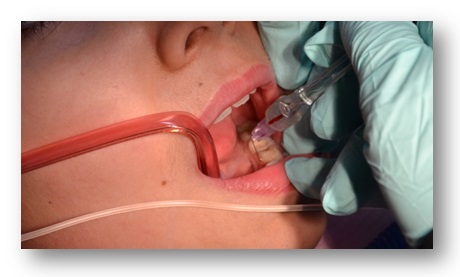
Single Tooth Anesthesia through intraligamentary technique called PDL. The advantages of this type of injection equipped with an intratissue pressure sensor – DPS (Dynamic Pressure Sensing Technology) are: fast (immediate) installation, absence of collateral anesthesia (soft tissue), the possibility to perform treatments in several quadrants in the same session. Regarding the anesthesia of the temporary molars, the injection is performed in two locations:
- dysto-lingual angle and mesio-lingual angle for mandibular molars
- dysto-buccal angle and mesio-buccal angle for maxillary molars
Fig 1. With the bevel oriented towards the tooth, advance about 2 mm in the periodontal space until firm resistance is felt.
Fig 2. Slowly inject (STA mode) about 1 ampoule into each site (mesiobuccal angle / distobuccal angle).
Fig 3. Slowly withdraw the needle from the periodontal space and check the installation of vasoconstriction (whitening of the fixed mucosa around the anesthetized tooth-fig. 3) which denotes the installation of anesthesia.
- Malka A, Sigalit B, Ilana E. Effectiveness of computerized delivery of intrasulcular anesthetic in primary molars, JADA. Vol. 136.
- J. Versloot, K.D. Craig. The communication of pain in Paediatric Dentistry. European Archives of Paediatric Dentistry // 10 (2). 2009. 61-66.
- J. G. Meechan. Pain control in local analgesia. European Archives of Paediatric Dentistry // 10 (2). 2009. 71-76
- J.F Tahmassebi, M. Nikolau, M.S. Duggal. A comparison of pain and anxiety associated with the administration of maxillary local analgesia with Wand and conventional technique. Dentistry // 10 (2). 2009. 77-82
- Nakai Y, Milgrom P, Mancl L, Coldwell SE, Domoto PK, Ramsay DS. Effectiveness of local anesthesia in pediatric dental practice JADA 2000; 131: 1699-705.
- Davidson L, Craig S. The use of periodontal ligament injection in children. J Dent 1987; 15:204-8.
- J. Versloot, Veerkamp JS, Hoogstraten J. Children’s self reported.
- Asarch T, Allen K, Petersen B, Beiraghi S. Efficacy of computerized local anesthesia device in pediatric dentistry. Pediatr Dent 1999; 21:421-4.
- Ram D, Peretz B. The assessment of pain sensation during local anesthesia using computerized local anesthesia(Wand) and a conventional syringe. J Dent Child (Chic) 2003;70:130-3.
- Allen KD, Larzelere RE, Hutfless S, Beiraghi S. Comparison of computerized anesthesia device with a traditional syringe in preschool children. Pediatr Dent 2002; 24:315-320.
- J.Veerslot, Veerkamp JSJ, Hoogstraten J. Computerized anesthesia delivery system vs. traditional syringe: comparing pain and pain-related behavior in children. Eur J Oral Sci 2005; 113:488-493.
- Nicholson JW, Berry TG, Smmitt JB, Yuan CH, Witten TM. Pain perception and utility: A comparison of the syringe and computerized local injection techniques. Gen Dent 2001; 167-172.
[/cmsms_text][/cmsms_column][/cmsms_row]