
[cmsms_row][cmsms_column data_width=”1/1″][cmsms_text]
Today, when even the common cold is suspicious and interpretable as COVID-19 pandemic, I, a dentist by profession, am entitled to seek clear and reliable information and answers to the questions that bother any dentist in the world: what to do now for myself and my patients?
As birds of a feather flock together, a discussion group was organized on Facebook, Dentists against Coronavirus, to which I joined and now counts approx. 33,000 members (doctors, researchers, academics) from around the world, including China, the USA, and, of course, Romania.
Thus, it wasn’t a surprise to find out that a study conducted on the matter of exposure of professions appeared in the New York Times on March 15, 2020, which states: dentists are about eight times more exposed to contracting the virus and the disease than an ordinary person, and the most exposed of the medical specialties, given the ergonomics specific to the profession:
– proximity to the patient (followed, in order, by paramedics and other medical categories, pilots and flight attendants, cashiers and others for whom it is not possible to keep a social distance);
– mouth wide open (oral cavity), which represents the “zero” point of activity in a dental office. However, it is known that once hosted by the human body, this coronavirus (SARS-CoV-2) is abundant in saliva and nasopharyngeal secretions near the mouth because SARS-CoV-2 can bind to positive ACE-2 cells, which are highly concentrated in the salivary glands. This could be a possible explanation for the abundant presence of SARS-CoV-2 in secretory saliva.
The risk of a dentist identifying with the COVID-19 case is indisputable (3): a person who was in the same room, having face-to-face contact with a COVID-19 case, at a distance of less than 2 m, during more than 15 minutes; a person from the medical staff or another person who provides direct care to a patient with COVID-19 or a person from the laboratory staff who handles samples taken from a patient with COVID-19, who is not wearing the protective equipment correctly.
Direct and indirect transmission
On the other hand, my pediatric patients (aged 0 to 18 years), although listed in the statistics as being at low risk of contracting the virus and with a low death rate (0.1% at 0-9 years and 0.2% at 10-19 years), can be good vectors of cross-transmission of the virus to both medical staff and the elderly and vulnerable, with low immunity, in their families.
And do you know that a recent report says that an adult instinctively touches his face about 23 times an hour (of which 40% are nose and mouth touches), and children even more often?
As it is already known, the transmission routes are not only directly (interpersonal), through an unprotected cough or sneezing aerosols, which can directly contaminate people within a radius of 2 m by inhaling them directly into the lungs or by depositing them on the nose, in mouth or face but also indirectly, by touching inert objects or surfaces on which the aerosols transmitted by the infected person have landed (deposited).
Therefore, standard and universal nosocomial infection prevention protocols should be complemented by additional measures and protocols that apply to all patients, regardless of infectious status, known or unknown.
Concerned about the same issues, my colleagues in Italy closed all offices. Likewise, in all US states, dental offices initially dealt only with emergencies, later to close them completely.
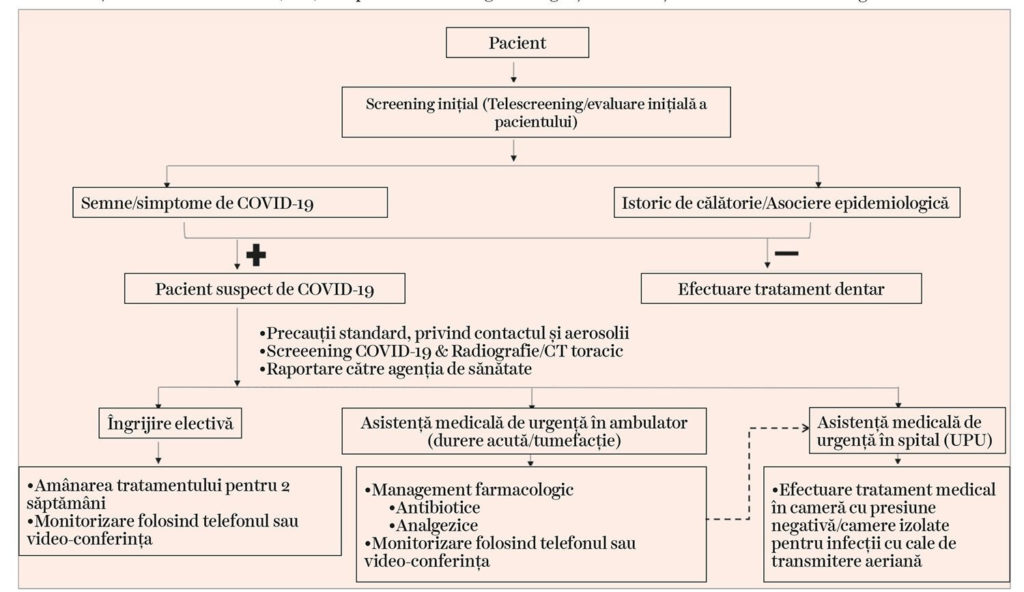
And if all infection control strategies are met (equipment, protocols, trained staff), then we should be very discerning and screening, according to the scheme inspired by Amber Ather BDS, DDS (see diagram below).
1. Patient screening and triage
1.1. Depending on the risk
Although the two most relevant questions for an initial (telephonic) screening are related to the history of travel over the last 14 days in areas affected by COVID-19 and the presence of any symptoms characteristic of febrile respiratory disease, there is a good chance that in emergency dental practice some of the asymptomatic patients, but infected with COVID-19, to be treated, taking into account that the incubation period of SARS-CoV-2 is variable and can last between 0 and 24 days.
Recent observations suggest that asymptomatic patients or patients during the incubation period are also possible vectors of SARS-CoV-2 (Chan et al. 2020; Rothe et al. 2020).
In addition, it remains to be seen whether patients in the recovery period are also a potential source of transmission (Rothe et al. 2020) because MERS-CoV RNA was detected in the lower respiratory tract even one month after the onset of the disease and the live virus could be isolated on the 25th day after the onset of symptoms. It should be noted that performing a single negative RT-PCR test does not exclude infection.
Considering the observations from above, although is unlikely that patients with active fever, above 38 ° C, or those with respiratory disease to report to the dental office (if they are sorted by telephone and invited to isolate themselves for about three weeks if the emergency allows it), however, every patient who enters the dental office, even the asymptomatic ones, must be considered potentially infected and all dental practices must be adapted to the revised infection control policies.
It is worth noting that patients with suspected or confirmed new SARS-CoV-2 coronavirus infection should not be treated in a routine dental setting.
1.2. Depending on the dental (medical-dental) emergency
Once the dental emergency diagnosis has been established, depending on its severity (see the emergency assessment questionnaire), the clinician:
– may delay treatment;
– can manage the case using alternative pharmaceutical methods (symptomatic antibiotic therapy and analgesics);
– can treat the emergency in his/her office using alternative chemo-mechanical methods (without using rotary instruments, especially high-speed ones, which can produce aerosolized sprays);
– can treat the emergency in his/her office using minimal rotary instruments (but only if he has the appropriate equipment recommended by the College of Dentists).
2. Emergency management: pre/ procedural conditions
a. The patient is advised to perform an effective brushing before the visit to the dentist. Previous studies show that SARS and MERS are very susceptible to iodine and that rinsing the patient’s mouth with 0.2% povidone-iodine could reduce the viral load of coronavirus in saliva. Optic White (2% hydrogen peroxide) is also recommended for children, and if it is not possible to rinse the mouth (the child is too young), a gauze soaked in solution is used.
b. Use disposable tools.
c. Extraoral radiography such as Panoramic or CBCT should be preferred to avoid vomiting reflexes or coughing through intraoral imaging procedures.
d. The use of rubber dam isolation also has the advantage of covering the patient’s nose.
e. Any procedure should avoid the use of ultrasonic or high-speed rotary instruments, which can produce contaminated aerosols.
The human coronavirus can survive on inert surfaces for up to nine days at room temperature and preferably in humid conditions.
Therefore, the dental team will take care to permanently disinfect the surfaces with the recently approved disinfectants for COVID-19 and to keep them dry.
A prudent dentist could use this summary (review) as a starting point to inform and be up to date in the common fight against this scourge. Doctors and patients, together we will succeed! By protecting ourselves, we protect you!
Bibliography:
1. https://www.facebook.com/groups/255221988819976/about/
2. https://www.nytimes.com/…/coronavirus-worker-risk.html. The Workers Who Face the Greatest Coronavirus Risk By Lazaro GamioMarch 15, 2020.
3. Case definition of COVID-19 Update 26 02 2020 Document prepared by the National Center for Surveillance and Control of Transmissible Diseases.
4. https://www.vox.com/2020/3/12/21173783/coronavirus-death-age-covid-19-elderly-seniors
5. ADA Calls Upon Dentists to Postpone Elective Procedures. Available at: https://www.ada.org/en/press-room/news-releases/2020-archives/march/ada-calls-upon-dentists-to-postpone-elective-procedures. Accessed March 16, 2020, n.d
6. Romanian College of Dentists. Recommendations for preventing the spread of COVID-19 in the emergency dental activity.
7. Coronavirus Disease 2019 (COVID-19): Emerging and Future Challenges for Dental and Oral Medicine L. Meng1, F. Hua2 , and Z. Bian1
8. Guan W, Ni Z, Hu Y, Liang W, Ou C, He J, et al. Clinical characteristics of 2019 novel coronavirus infection in China. medRxiv 2020.02.06.20020974; Available from: https://www.medrxiv.org/content/10.1101/2020.02.06.20020974v1
9. Wu Z, McGoogan JM. Characteristics of and Important Lessons From the Coronavirus Disease 2019 (COVID-19) Outbreak in China: Summary of a Report of 72 314 Cases From the Chinese Center for Disease Control and Prevention. JAMA 2020 Feb 24. doi: 10.1001/jama.2020.2648.
10. Rothe C, Schunk M, Sothmann P, Bretzel G, Froeschl G, Wallrauch C, et al. Transmission of 2019-nCoV Infection from an Asymptomatic Contact in Germany. N Engl J Med 2020 Mar 5;382:970-971. doi: 10.1056/NEJMc2001468.
11. L. Meng, F. Hua, Z. Bian. Coronavirus Disease 2019 (COVID-19): Emerging and Future Challenges for Dental and Oral Medicine /First Published March 12, 2020
12. Amber Ather, BDS, DDS1, Biraj Patel, BDS1, Nikita B. Ruparel, MS, DDS, PhD1, Anibal Diogenes, DDS, MS, PhD1 and Kenneth M. Hargreaves, DDS, PhD1Coronavirus Disease 19 (COVID-19): Implications for Clinical Dental Care
Article first published in the Medical Life journal -https://www.viata-medicala.ro/diverse/mergem-sau-nu-la-dentist-16191
[/cmsms_text][/cmsms_column][/cmsms_row]